Insight··6 min read
Why latency, not bandwidth, decides whether a superyacht's internet actually works
Owners now run companies, trade and take board calls from the aft deck. The number that makes or breaks that is milliseconds, not megabits — and it is set by the path ashore, not the antenna.

Ask most people what makes yacht internet good and they will answer in megabits. Ask the owner who just dropped off a board call in the Balearics, or the ETO who watched a guest's video game stutter through a whole charter, and you will get a different answer. What they felt was latency.
Since the pandemic, the people on board have changed what they do there. Owners who once came aboard to disconnect now run large organisations from the yacht for weeks at a time. They take investor calls from the sky lounge, sign documents from the tender, and in some cases trade from a cabin desk with three screens. Their guests expect the same cloud gaming, 4K streaming and video calls they get at home. All of that is sensitive to delay in a way that plain downloads never were.
What latency actually is
Latency is the time it takes for a packet to leave the yacht, reach its destination and come back, measured in milliseconds. Bandwidth is how many packets fit through the pipe at once. A wide pipe with a long delay feels slow for anything interactive, because every click, every word on a call and every keystroke in a remote desktop session has to make the full round trip before anything happens.
Three things feed into that round trip at sea:
- Distance. A geostationary satellite sits 36,000 km up, so a GEO link starts at roughly 600 ms before anything else is added. Low-earth-orbit constellations such as Starlink and OneWeb bring that down to the 60 to 100 ms range.
- Hops. Every network the traffic crosses between the ground station and the destination adds its own delay, its own queues and its own chance of congestion.
- Consistency. Two other numbers ride alongside latency. Jitter is how much the delay varies from packet to packet, which is what turns a call choppy. Packet loss is how many packets never arrive and have to be resent, which is what turns a 4K stream into a spinning wheel.
Where the milliseconds really go
Here is the part the brochures leave out. On a typical yacht setup the satellite hop is only the beginning of the journey.
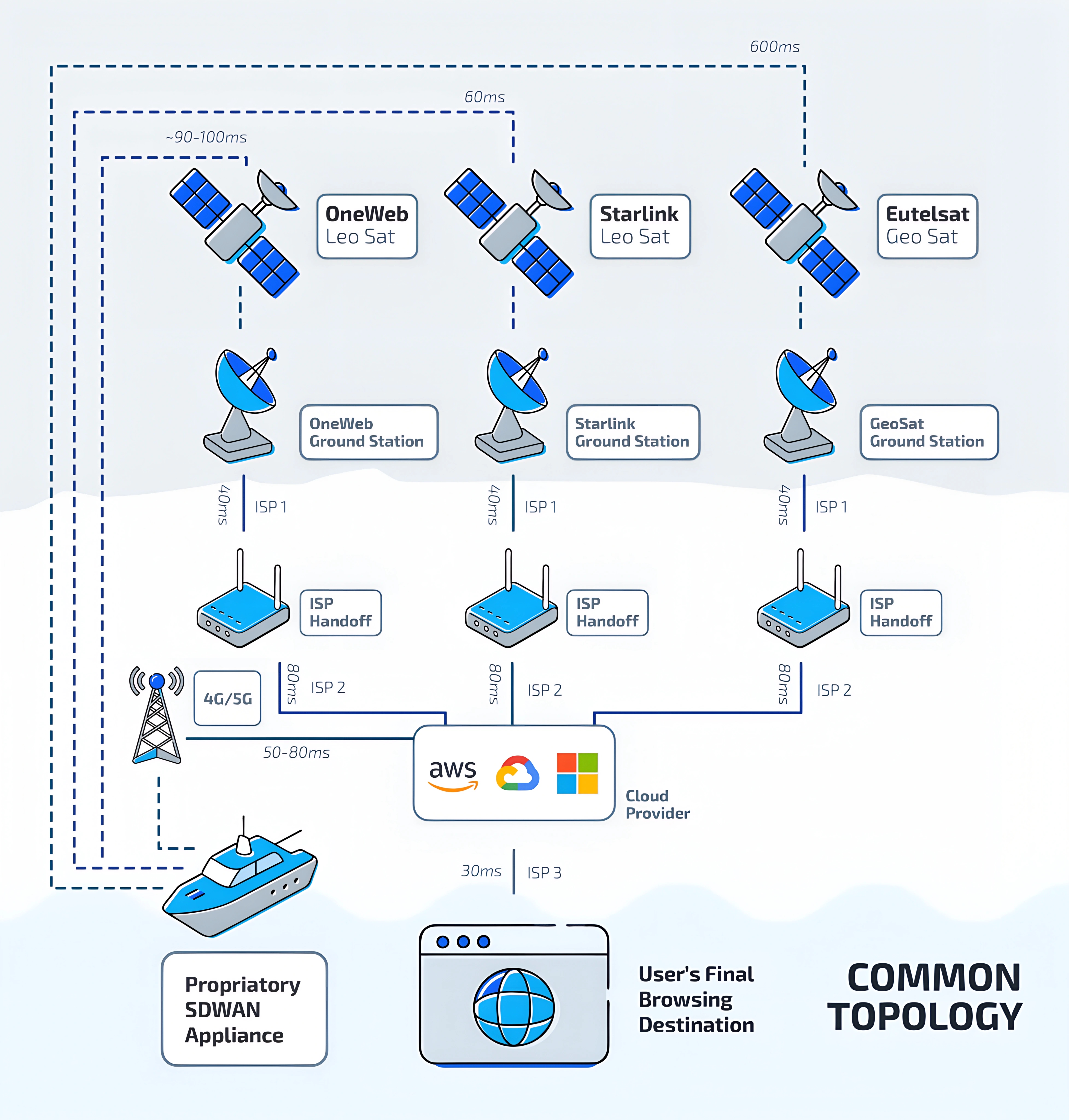
The antenna talks to a ground station. From there the traffic is handed to one internet provider, then another, then into a public cloud region where the yacht's bonding server happens to be hosted, then out through yet another provider to wherever the owner's video call actually lives. Each handoff is a queue, a change of network and a place where packets can be dropped. In the arrangement above, the hops after the ground station add around 150 to 200 ms on top of the satellite itself. The satellite was never the problem. The detour was.
That is why two yachts on the same Starlink plan can have completely different experiences. One has a 60 ms satellite hop and a 20 ms path ashore. The other has the same 60 ms satellite hop and a 200 ms tour of the public internet.
Bonding without the detour
NEGU was built to remove that tour. We run our own hubs, our own backbone and our own peering, and we place the hubs where the satellite traffic lands rather than in a cloud region on the other side of a continent.
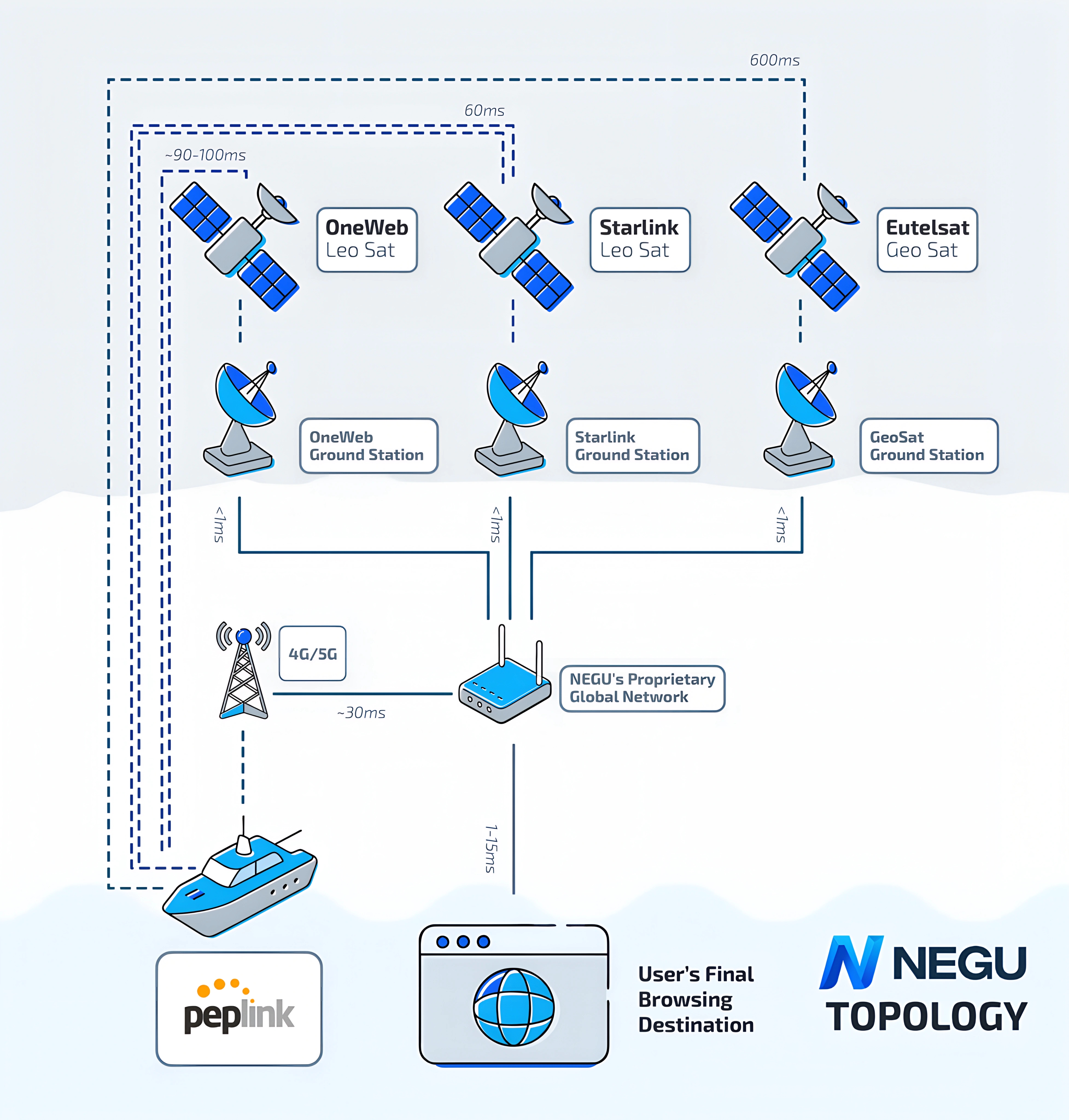
The yacht's SD-WAN appliance, whether Peplink, Fortinet, Kerio or any open-market unit, bonds Starlink, OneWeb, GEO and 4G/5G into one connection that terminates on a NEGU hub. From the ground station to that hub is under a millisecond. From the hub to the owner's video-conferencing platform, trading venue or streaming service is typically 1 to 15 ms, because we connect directly to more than 1,500 networks, including the content and cloud providers that carry almost everything people on board actually use.
Bonding matters for consistency as much as for speed. When a Starlink cell is congested or an obstruction drops the beam for a second, the session carries on over the other links without the call noticing. Jitter smooths out because the hub, not the public internet, decides which packet goes where. And because each customer runs on a dedicated hub instance, the throughput one yacht gets is never shared with the boat in the next berth. That is the difference between a bonded connection and a bonded connection that happens to be low latency.
What that means for the people on board
- The owner's office. Video calls hold together at 4K with no lag between speaking and being heard. Remote desktops and cloud apps feel local. A trading platform sees a round trip measured in tens of milliseconds, not hundreds.
- Guests and family. Cloud gaming, live sport and streaming behave as they would ashore. Nobody asks the ETO why the film keeps buffering.
- The crew. Provisioning orders, ISM systems, telemedicine sessions and the captain's own calls to the management company all stop competing with the guest deck for a clean path.
- The ETO. One bonded connection with predictable latency is far easier to run than four links that each behave differently, and it removes the most common source of "the internet is slow" complaints at the worst possible moment.
Questions to ask any provider
If you are evaluating connectivity for a new build, a refit or simply a season that has to go better than the last one, ask these before you ask about price per gigabyte:
- Where does my traffic leave the satellite operator's network, and where does your bonding server sit relative to that point?
- How many networks does my traffic cross between your hub and the services my owner uses? Do you peer with them directly?
- What round-trip time and jitter should I expect from the yacht to a major video-conferencing platform in Europe and in the United States?
- Is my hub shared with other customers?
- What happens to a live call when one link drops?
If the answers are vague, the milliseconds will not be.
The short version
Bandwidth gets you on the internet. Latency decides whether the people on board can work, trade, play and relax on it. The antenna sets the floor, but the path from the ground station to the destination sets the experience, and that path is the part most providers leave to chance.
NEGU exists to take it out of chance. Explore the network, read about how SpeedFusion bonding works, or talk to us about what your yacht should expect this season.
About NEGU
NEGU is a network- and infrastructure-as-a-service provider for superyachts and private aviation. It runs its own hubs, private backbone and servers, delivering bonded connectivity at sea, a managed Peplink FusionHub service with unlimited data, colocation, and secure remote-access designs aligned with IACS E26.
Press enquiries: get in touch